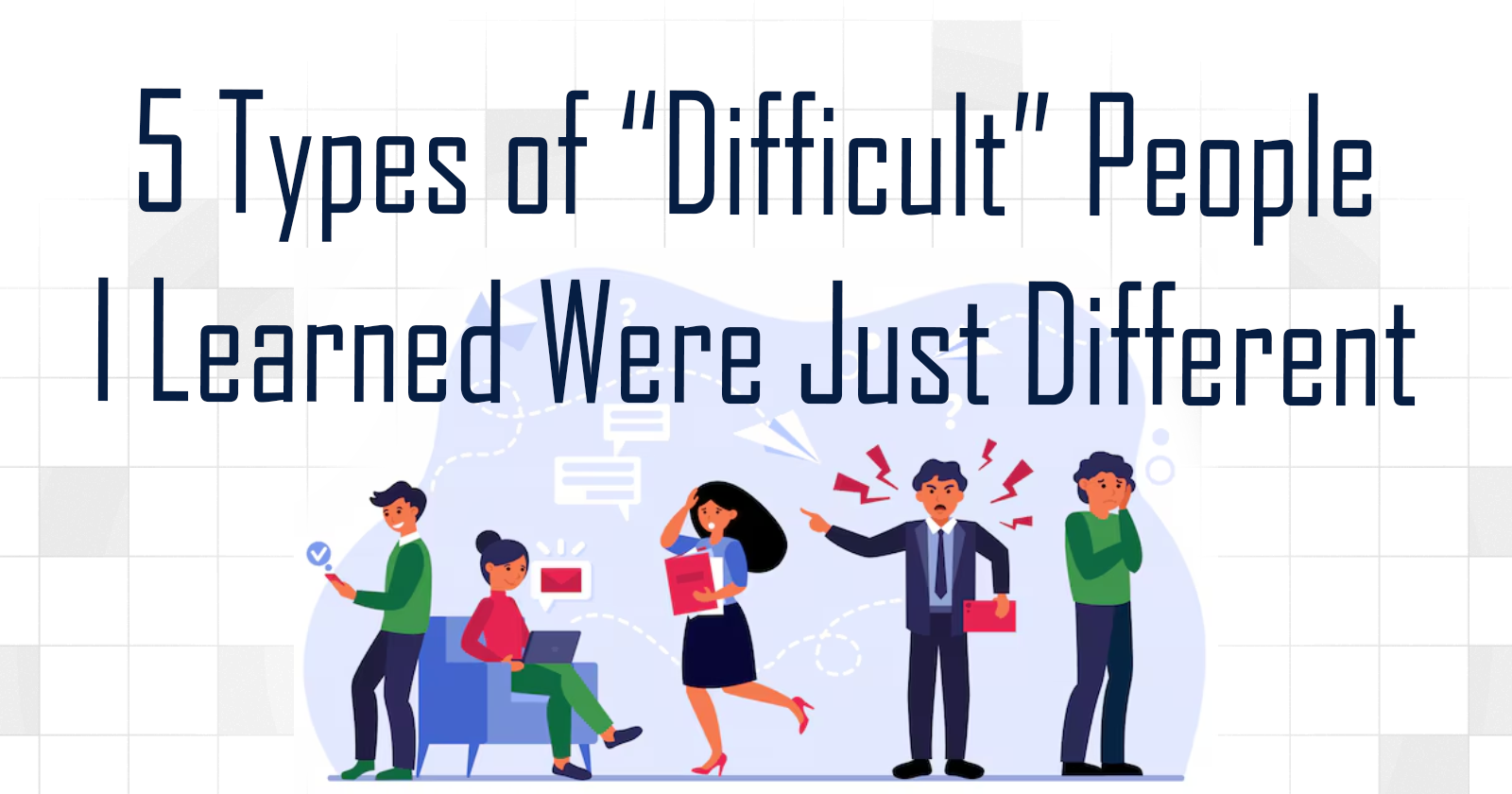
5 Types of “Difficult” People I Learned Were Just Different
Welcome back to another Articles by Victoria, the place where I randomly write things I’m curious about.
This week, I found myself thinking about a phrase we use way too casually at work.
“Difficult people.”
Often, I hear people labelling others easily. Like if someone asks too many questions… Difficult. Or if someone pushes back hard in meetings… Difficult. Or maybe someone who refuses to align with the group… Difficult.
I used to mentally label people as well who I find “difficult”. In my 6 years as a solutions engineer, it's safe to say I've dealt with a lot of types of people. That’s when I realised most people we call difficult are not actually difficult. They are just different.
They are just different from usual people you talk to so you find them "difficult". We are all biased and we like to stick to the familiar. We like to only talk with people who we are comfortable with. And because humans are wired to prefer familiarity, we quietly turn difference into friction.
This article is not about how to deal with difficult people.
It is the result of years of quiet observation. Years of conversations, meetings, calls, demos, escalations, follow ups, and the kind of interactions that stay in your head long after the calendar invite ends. As a solutions engineer, I do not just work with technology. I work with people.
And over time, I started noticing patterns. Like recurring archetypes of people who think differently, communicate differently, react differently, and often get labeled as difficult simply because they do not fit the type of people we are most comfortable talking to.
And if you have followed me for a while, you know I love documenting everything. So I started documenting these archetypes, reflecting on my own reactions to them, and slowly learning how to work with each type without burning out or taking things personally. This article is a reflection of those observations and the ways I learned to deal with different kinds of people.
Preface: The biases we have to admit
I would like to preface this article with the fact that we are biased creatures and that my perspectives, experiences or observations can be subjective to a certain extent. As humans, we like to believe we are open minded. I thought I was pretty open-minded until writing this article. I thought as someone who lived in many different countries growing up, speaking different languages, and adapting to different cultures, I would value more diversity of perspectives.
But if I’m being honest with myself, I still most at ease with people who think similarly to me. Why do I enjoy books like “Atomic Habits” or “Building a 2nd brain”? Simply because the authors wrote and explain in systems which is something I’m most comfortable with.
This bias is subconscious and it’s more present in our daily communication with others than you might think. We like the familiar because it is efficient. It takes less energy to communicate with people who operate on the same wavelength. There is less explaining, less emotional regulation required.
But my job as a solutions engineer does not allow me to live in that comfort bubble.
I do not get to choose who I speak to. I speak to founders, engineers, security teams, procurement, product managers, compliance officers, etc. And over the years, patterns started to emerge. Along with these patterns, I myself recognize the biases I hold.
It made me shift my perspectives. Instead of asking why someone was being so hard to deal with, I started asking why this particular interaction was triggering discomfort in me. Was it challenging my sense of competence? Was it slowing me down? Was it forcing me out of my communication comfort zone?
Archetype 1: Highly Anxious Questioners
These are the type who ask a lot of questions. Then ask even more, before circling back to questions you already answered. They are usually very detail-oriented and carry a lot of responsibilities in their job. If something goes wrong, it is on them.
That’s why I slowly realized their questions are a way to reduce their uncertainties. Instead of simply responding to their questions again and again, almost reaching to a point of frustration, I proactively reassured their underlying concerns and covered edges cases in advance.
They now feel more confident that I can look out for them, and our collaboration is not their sole responsibility to uphold. They were not difficult, but risk sensitive.
Archetype 2: Strong Opinion Holders
This is quite a common type. A person who is vocal, appears confident, know what they believe in, and expect others to agree. To be frank, I still struggle with this type. Because their certainty felt intimidating and they can be sometimes dismissive to others’ opinions.
However, I slowly discovered that these strong opinions tend to come from deep experiences, mostly negative. They have seen implementation fails, production collapsing, performance bottlenecks and fragile architectures. Trying to debate or overpower them is futile because they know they’re right.
What I find works is showing curiosity for their perspectives. Ask them why they believed a certain way would work, why they had to insist on a particular flow. They end up sharing their reasoning behind their opinions, and when people articulate their own experiences, they are able to soften because they felt heard. They would shift from being defensive to being reflective.
Sure, they won’t change their minds most of the time but for the rest of the people in the room, their “strong opinions” become a story with context. Now that we learned about their story, the constraints they faced at the time, their challenges, we can discuss solutions. We can evaluate what went wrong in the past and explore better trade-offs and options.
They were not difficult, they just had an unshared story.
Archetype 3: Silent Skeptics
Silence is the most powerful weapon because it hides everything from you. Their doubts, confusion or any areas of resistance, these types are usually existing quietly and when the time comes for decisions to be made, the objections appear out of nowhere.
I assume some of us might made this mistake before: treating silence as consent.
But this is a dangerous assumption to make. Silence does not necessarily mean agreement. It can signal discomfort, distrust, or just that this person is the type to process internally before speaking.
So I learned to create space for these archetypes. If they have no questions in the call, that doesn’t mean they have no questions or doubts later. Ask follow up questions or suggest a call sometime in the future. Give them space to process and come back later anytime. Keep the conversations transparent and open so they will feel space to raise concerns before it’s too late.
They were not difficult, they just need the space and time.
Archetype 4: Agreement Seekers
There are moments in my role where I have to be the devil’s advocate. Because there are certain constraints cannot be negotiated away. Security boundaries still matter, architectural tradeoffs still exist even if they are inconvenient. Some decisions, once made, need to be protected for the sake of long term stability.
On the surface, agreement seekers are some of the easiest people to work with. They are polite, collaborative, and genuinely want everyone to feel heard. They value alignment and harmony.
And when they are not in positions of power, this tendency is usually manageable.
The challenge is when an agreement seeker holds authority but struggles to remain objective. In an effort to keep peace, they may loosen constraints that should stay firm. They may lose sight of priorities or decisions that were previously discussed and agreed upon, and end up accommodating to whoever speaks most confidently or holds the most influence in the room.
What makes this difficult is that it rarely feels intentional. They are just trying to reduce tension. But in doing so, clarity is sacrificed for comfort.
In these situations, I learned to thread carefully because if I came across as too firm, they would instinctively move away from my side to rebalance the room. What worked better for me was grounding my pushback in shared goals and framing constraints as protection rather than obstruction. Usually, that would help them facilitate the discussion to reach an agreement.
They were not difficult, they were harmony-driven.
Archetype 5: Lost in Conversation Narrators
I’m honestly still lost when it comes to this archetype. This type frustrates me the most because it’s absolutely baffling. They are very friendly and like to talk a lot. Yet somehow the more they talk and explain, the more confused I get.
They describe their problem, but the description keeps digressing. They use technical terms, but not quite correctly and it made me not understand what they’re trying to say. When I ask a question to clarify, their answers are completely irrelevant that it feels like we are having two completely different conversations in parallel.
This happens most often with non technical stakeholders, but not exclusively. Their intent is not to confuse. In fact, many of them are trying very hard to explain and it would frustrate them too if I don’t understand what they’re trying to convey.
What makes this especially difficult is that I cannot easily tell where the gap is. Are we missing shared vocabulary? Are we misaligned on context? Are they still figuring out the problem themselves?
This archetype forces me to confront my own limits. My instinct is to move towards structure, precision, and abstraction. But not everyone thinks that way. Some people reason through narrative and they have to say things aloud as a way to think through what they want to actually say.
In many instances, I have found that letting them talk it out is actually the solution. I first had to let go of the assumption that they had come into the meeting with clarity. Whatever words they are saying, no matter how disorganized and scattered, I would capture all of it then distill them by myself later. Rather than a requirements gathering, I treat their narratives as a form of discovery process, for themselves and for me.
They were not difficult, they were just still forming thoughts.
The Life-Changing Hack
After discovering the patterns of these 5 types, I no longer treat every “difficult” person as a problem to fix. I don’t end up micro-managing my relationships and try to artificially repair the misalignment, the misunderstandings, the non-verbal barriers.
The biggest life-changing hack is simply about emotional regulation.
Can you stay grounded when someone challenges you?
Can you listen without being defensive?
Can you separate tone from intent?
Once this becomes ingrained and automatic within me, the rest becomes easier. The small moments of confusion and frustrations may not entirely disappear, but I can immediately reset myself to focus on solving what the clients’ needs are, instead of trying to decode our communication barriers or misalignments.
Conclusion
It is not within my control to change someone’s behaviour, but it is within my control to change myself to better work with them. Understanding that they are just different helps me a lot. I also realized how I might also be somebody else’s “difficult” person and that’s why being aware of your own pitfalls is just as important when it comes to communicating with different people.
Thanks for reading! I’m curious to know your own personal thoughts and experiences on this topic! Feel free to connect or let me know in the comments! Cheers!


